What Are Retort Tubes and Pyrolysis Tubes, Are They the Same Item?
In discussions of charcoal, biochar, and biomass processing, the terms retort tube and pyrolysis are often used together. This can lead to misunderstandings as if retort is pyrolysis or both are the same thing.
In fact, retort and pyrolysis are not the same thing.
To put it simply:
Pyrolysis is the process, while retort is a tool or reactor that can be used to carry out the process.
The relationship between the two can be analogous to cooking and a pan. Cooking is a process, while a pan is a tool used to carry out that process. Likewise, pyrolysis is a thermochemical process, while a retort is a type of container/reactor that can be used to carry out the carbonization or pyrolysis process of biomass.
1. What is Pyrolysis?
Pyrolysis is the process of decomposing organic materials using heat in conditions of very limited oxygen or no direct oxygen.
When biomass is like:
- wood,
- rice husks,
- coconut shell,
- corn cobs,
- straw,
- bamboo,
- plantation waste,
heated to a certain temperature without complete combustion, the organic structure begins to decompose.
The process produces several main fractions:
- solid product → char or biochar,
- liquid products → bio-oil/pyrolysis liquid,
- gas products → pyrolysis gas or syngas.
The International Biochar Initiative also explains that pyrolysis-based biochar production systems use kilns, retorts, or other special equipment to hold biomass while limiting the entry of oxygen.
So, pyrolysis is not the name of a tool, but rather the name of the process of changing biomass due to heat in a low oxygen environment.
2. What is a Retort Tube?
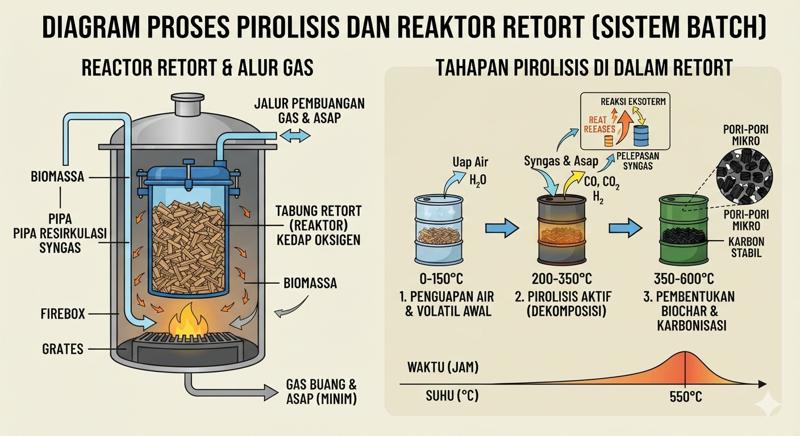
A retort tube is a container or closed reactor chamber used to heat materials in a controlled environment, especially for carbonization or pyrolysis.
In a retort system, biomass is placed in a chamber/tube that is relatively isolated from outside air.
Heat is provided from the outside or through a certain heating system so that the biomass in the retort undergoes a carbonization process.
This concept is different from a simple stove which burns part of the biomass directly to produce heat.
In a retort system, the main purpose is to separate the material to be carbonized from the direct combustion source.
Gases and steam that come out of biomass can be directed outside and, in certain systems, burned again to produce heat for the carbonization process. The concept of reusing gas is one of the advantages of retort technology.
3. So, Are Retorts and Pyrolysis the Same Thing?
No.
The difference can be made very simply:
| Retort | Pyrolysis |
|---|---|
| Is a tool/reactor | Is a process |
| In the form of a chamber or tube | This is a thermochemical reaction |
| Becomes a place where biomass is heated | Decomposing biomass with heat |
| Can be used for carbonization | Can be done using various types of reactors |
| One of the technologies for running the process | Not limited to one form of tool |
Thus:
Retort → tools
Pyrolysis → process
Biochar → one of the products that can be produced
The relationship is approximately:
Biomass → Retort → Pyrolysis → Biochar + Gas + Liquid
However, it should be noted that not all processes carried out in retorts should be strictly called pyrolysis. The term retort better describes the design or configuration of the reactor, while pyrolysis describes the thermochemical process.
4. How Does a Retort Perform Pyrolysis?
Imagine a metal tube that can be closed.
Biomass is put into the tube. Then the tube is heated from the outside.
For example:
Biomass → Retort Tube → Warm up → Thermal Decomposition
When the temperature increases, water evaporates first. After the temperature gets higher, organic components such as hemicellulose, cellulose and lignin begin to experience thermal decomposition.
The biomass then loses most of its volatile components and leaves a solid material that is richer in carbon.
In the slow pyrolysis process, the temperature conditions, heating rate and residence time are created in such a way that the formation of char/biochar is more dominant. The literature shows that slow pyrolysis generally uses relatively slow heating and temperatures of around 300–550 °C, although the operating range can vary depending on the materials and reactor design.
5. Retort Can Be Used to Make Biochar
This is an important part in the agricultural context.
Retorts can be used as a biochar production technology
When agricultural biomass is put into a retort and processed using appropriate pyrolysis conditions, the resulting solid product can be biochar.
The quality of biochar is greatly influenced by:
- type of biomass,
- water content,
- particle size,
- temperature,
- heating rate,
- long process,
- residence time,
- oxygen conditions,
- reactor design.
So, just having a retort does not guarantee producing good quality biochar.
The process settings remain very decisive.
Research on retort kilns shows that the carbon content of the product can increase at higher temperatures; the study reports products with a carbon content of ≥50%, while a content of ≥75% can be achieved at temperatures around ≥500 °C in a number of materials and systems studied.
6. Why is a Retort Different from a Traditional Charcoal Stove?
In traditional charcoal stoves, some of the biomass is usually burned to produce the heat needed for carbonization.
As a result, some of the raw materials were burned.
In retorts, the principle is different.
The biomass that wants to be carbonized is placed in a closed room, while heat can be provided from outside. The volatile gases that come out of biomass can even be reused as fuel.
FAO explains that modern retorts can utilize the gas produced during carbonization to provide heat for the subsequent process so that the need for direct combustion of wood can be reduced.
Therefore, retorts can provide better process control than traditional open burning or furnace methods.
7. Retort Doesn't Always Mean "Pyrolysis Tube"
In practice in the field, the term retort is often used widely.
There is a retort of the form:
- tube,
- cylinder,
- box,
- horizontal space,
- vertical space,
- batch reactor,
- even continuous systems.
So, when someone says "retort tube", what is usually meant is the tube-shaped part of a retort reactor system.
Meanwhile, pyrolysis does not have one particular form of equipment.
Pyrolysis can be carried out using various types of reactors, such as:
- fixed-bed reactor,
- retort reactor,
- rotary kiln,
- auger reactor,
- fluidized-bed reactor,
- microwave reactor,
- vacuum reactor.
The study of pyrolysis technology shows that reactor design, temperature, heating rate, residence time, and reaction conditions influence product distribution between biochar, bio-oil, and gas.
8. Retort and Slow Pyrolysis Are Very Suitable for Biochar
If the primary goal is to produce biochar, then a common approach is slow pyrolysis.
Slow pyrolysis uses relatively slow heating and a longer residence time than fast pyrolysis. These conditions provide a greater opportunity for biomass to undergo carbonization and produce a solid fraction.
Therefore, the correct relationship is:
Retort
↓
Reactor
↓
Slow Pyrolysis
↓
Biomass Carbonization
↓
Biochar
In other words, aretort can be a "home" for the slow pyrolysis process.
Recent studies also place slow pyrolysis as one of the important pathways for producing biochar, with process characteristics controlled by temperature, heating rate, residence time, and reactor design.
9. Don't Confuse Retort with Biochar
There are three terms that need to be separated:
Retort
Equipment or reactor.
Pyrolysis
Thermochemical processes.
Biochar
A carbon-rich solid product resulting from biomass processing under certain conditions.
So it is not correct to say:
"Retort is biochar."
What is more correct:
"Retort is a type of reactor that can be used to carry out the pyrolysis or carbonization process of biomass to produce biochar."
10. Conclusion
Retort tubes and pyrolysis are not the same thing.
Retort is a reactor device or chamber, while pyrolysis is a thermochemical process that occurs when biomass is heated with very limited oxygen.
In biochar production, the two have a very close relationship:
Biomass
↓
Retort
↓
Controlled heating
↓
Pyrolysis/carbonization
↓
Biochar + gas + volatile products
The advantage of the retort system lies in its ability to isolate biomass from direct combustion and allow the process gas to be reused as a heat source. By setting the right temperature, residence time, heating rate and oxygen conditions, retorts can be an effective technology for slow pyrolysis-based biochar production.
So, if we simplify:
Pyrolysis is the "process", retort is the "tool", while biochar is one of the "results".
5 Literature
- Ighalo, J. O., Eletta, O. A. A., & Adeniyi, A. G. (2022). Biomass carbonisation in retort kilns: Process techniques, product quality and future perspectives. Bioresource Technology Reports, 17, 100934.
- International Biochar Initiative (IBI). Biochar Technology – Pyrolysis Systems IBI describes the use of kilns and retorts as systems for carrying out biomass pyrolysis with oxygen limitation.
- Biochar production via crop residue pyrolysis: Development and perspectives. Bioresource Technology, 2022. Discusses various pyrolysis technologies and the influence of process conditions on biochar production.
- Pyrolysis technologies for biochar production in waste management: a review. Clean Energy, Oxford Academic. Discusses slow pyrolysis, reactor types, temperature, heating rate, and residence time in biochar production.
- Parametric influence of process conditions on thermochemical techniques for biochar production: A state-of-the-art review. Journal of the Energy Institute, 2024.Discusses the relationship between pyrolysis process parameters and biochar characteristics and yield.