Application of Binary AI Models to Support Plant Watering Decisions
Water is an important component in plant growth. Availability of appropriate water can help plants grow well, while lack of water can disrupt growth. On the other hand, giving too much water can also cause inefficient use of resources.
These conditions encourage the emergence of the need for an agricultural system that is able to determine water needs based on data. Artificial Intelligence can be used to assist this process. One approach that can be tested is the binary classification model.
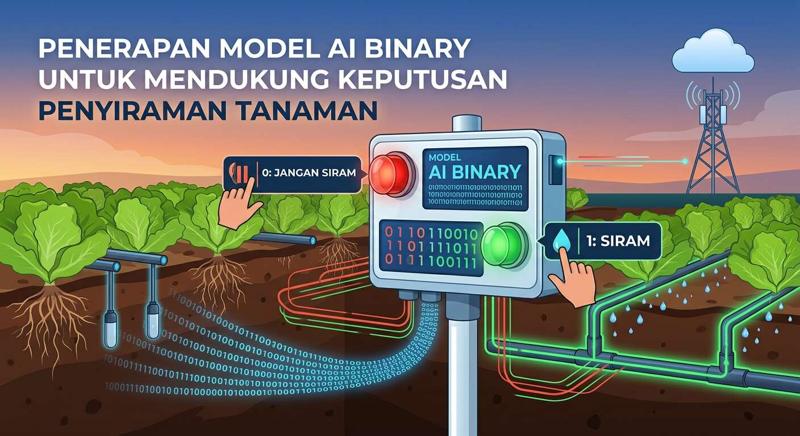
The binary model can produce decisions in two categories, for example "needs watering" and "does not need watering". In this way, information from sensors can be converted into simpler recommendations for farmers.
Data as a Basis for Decisions
To create an AI-based watering system, data is needed that describes land conditions. One of the main data is soil moisture.
However, soil moisture is not the only parameter that can be used. Temperature, air humidity, rainfall, light intensity, plant type, soil type, and plant age can be supporting factors.
This data is collected periodically. Each condition is then associated with a watering decision. Data can be labeled 0 and 1 according to the decisions that have been determined.
For example, label 0 means the land does not need watering, while label 1 means the land needs watering.
Dataset Development
Datasets are an important component in implementing AI. The data used must describe conditions that are diverse enough so that the model does not only recognize one particular condition.
For example, data collection is carried out in the morning, afternoon and evening. Data can also be collected when the weather is sunny or after rain.
The more diverse the conditions contained in the dataset, the more patterns the model can learn. However, the data must still be relevant and have the correct labels.
Labeling errors can cause the model to learn relationships that do not match actual conditions.
System Testing
Trials can be carried out on a limited scale. Several sensor points are placed on the land to measure soil conditions.
The sensor then sends data to the processing system. The data is processed and provided to the AI model. The model produces predictions in the form of 0 or 1.
If the result is 0, the system can provide the status "No Watering Required". If the result is 1, the system gives the status "Requires Watering".
In the early stages, these results should only be used as recommendations. Farmers can check the condition of the soil directly before taking action.
Integration with IoT
Binary AI models can be developed together with the Internet of Things. Sensors located on the land can send data automatically to the server.
The server then runs the prediction process. The results can be displayed on the dashboard or sent via notification.
Further development allows the system to be connected to an automatic watering device. However, automation must be done carefully.The system needs to have limits so that sensor errors do not cause watering to run continuously.
The use of manual controls as a backup may also be part of the system design.
Water Use Efficiency
One of the potential benefits of the system is that it helps use water in a more targeted manner. Watering can be based on the actual condition of the land rather than just following a fixed schedule.
Historical data can also be used to see patterns of water demand. Farmers can know when soil conditions are likely to need water and how weather changes affect moisture.
This information can be used as evaluation material for land management in the next period.
Evaluate Prediction Results
The model needs to be tested using data that is not used in the training process. This aims to determine the model's capabilities when dealing with new data.
Several metrics such as accuracy, precision, recall, and F1-score can be used to evaluate the model.
In addition to technical evaluation, field evaluation is also needed. Prediction results must be compared with actual soil conditions. If there are differences, the causes need to be analyzed.
These differences can be caused by sensors, data quality, weather changes, or model limitations.
Conclusion
The application of binary AI models to support watering decisions is one example of the use of artificial intelligence that is relatively easy to understand. The system can convert various environmental parameters into simple decisions regarding watering needs.
The integration of AI with sensors and IoT can make the monitoring process more structured. However, implementation should start on a small scale and carry out regular evaluations.
With increasingly complete data, models can be developed to better suit land conditions and the types of plants used.