Difference between Charcoal and Biochar: From Process, Carbon Content, to Benefits
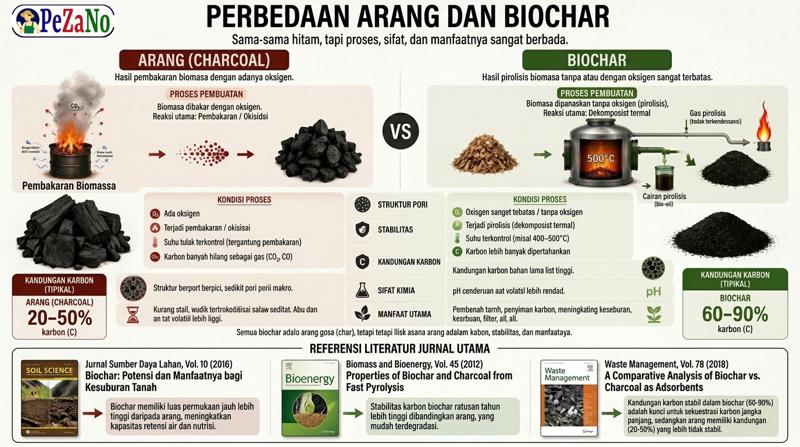
Charcoal and biochar are often considered the same material because they are both black in color, come from biomass, and have a high carbon content. However, in terms of function and purpose of manufacture, charcoal and biochar have very important differences.
The difference lies not only in how it is made, but also in the purpose of use, the character of the carbon, the stability of the carbon, and the benefits to be obtained.
In simple terms, charcoal is generally made to produce fuel, while biochar is made as a relatively stable carbon material for soil, agricultural, environmental and carbon storage applications.
1. What is Charcoal?
Charcoal is a carbon-rich solid material produced from heating biomass with limited oxygen. The materials used can be wood, bamboo, coconut shells, twigs, or other biomass.
In traditional use, the main purpose of making charcoal is to produce fuel that has a high calorific value.
Charcoal is then used for:
- cooking;
- burning;
- industrial fuel;
- briquette making;
- various other energy needs.
Because its main purpose is energy, the characteristics that are usually considered in charcoal are heating value, water content, ash content, fixed carbon, flammability, and physical strength.
Thus, the carbon contained in charcoal is basically chemical energy stored in carbon material.
When charcoal is burned, the carbon undergoes oxidation and most of it is converted into carbon dioxide (CO₂), while producing energy in the form of heat.
In simple terms:
Biomass → Charcoal → Burning → CO₂ + Energy
2. What is Biochar?
Biochar is a carbon-rich material produced through thermochemical biomass processes, especially pyrolysis in very limited oxygen conditions, with the aim of producing carbon material that can be utilized for soil, agriculture, the environment and carbon storage.
The raw materials can come from:
- rice husks;
- straw;
- corn cobs;
- plantation waste;
- twigs and wood waste;
- bamboo;
- coconut shell;
- livestock waste;
- various other biomass residues.
In the pyrolysis process, biomass is heated without complete combustion. Some of the material turns into gas and volatile compounds, while some of the carbon remains in solid form.
This solid fraction can then become biochar.
However, not all charcoal automatically becomes biochar.
Carbon material made for fuel is called charcoal based on its main function. Materials that are produced and controlled for soil or environmental applications can be categorized as biochar.
3. Carbon Content: Main Similarities of Charcoal and Biochar
Both charcoal and biochar are rich in carbon.
Carbon is an important component of both because the heating process causes most of the volatile biomass components to come out, while carbon becomes increasingly concentrated in the solid fraction.
However, carbon content does not have one value that applies to all charcoal or biochar.
The type of raw material, pyrolysis temperature, heating time, water content and process conditions greatly influence the final carbon content.
In biochar, various studies show that the carbon content can be in a very wide range. One comprehensive study reported biochar carbon content of approximately 62.2–92.4%under various combinations of raw materials and pyrolysis conditions.
This shows that the term "biochar" does not mean it has a carbon content of a certain number. The character of biochar must be seen based on the raw materials and production process.
4. Carbon in Charcoal: Stored Energy
In charcoal fuel, carbon primarily has value because it can produce energy when burned.
The carbon is a source of chemical energy.
The better charcoal is used as fuel, the more effectively the carbon is oxidized and produces heat.
Therefore, from an energy perspective:
Charcoal carbon → burned → generates heat → carbon returns primarily as CO₂
This means that carbon previously stored in biomass is only transferred temporarily into charcoal before finally being released again when the charcoal is burned.
This is the basic difference between the perspective of charcoal as a fuel and biochar as a carbon storage material.
5. Carbon in Biochar: What's important is not just a lot, but stability
In biochar, the presence of carbon has a different function.
An important goal of the pyrolysis process is to convert some of the biomass carbon into a carbon structure that is more stable and more difficult to decompose.
During the pyrolysis process, cellulose, hemicellulose, lignin and other organic components undergo changes due to heat.
Some volatile compounds come out as gas and vapor, while some carbon undergoes structural changes to become more condensed and aromatic carbon.
The result is a carbon material that is more resistant to decomposition than most of the biomass from which it originates.
In simple terms:
Biomass → Pyrolysis → Carbon-rich biochar → Carbon is relatively stable → Land
Therefore, in the context of biochar, there are two concepts that must be distinguished:
Carbon content and carbon stability.
Carbon content answer:
How much carbon is there in biochar?
Meanwhile, carbon stability answers:
How difficult is it for the carbon to break down and return to the atmosphere?
The two are not the same.
High carbon does not automatically mean very stable carbon
6. Why is Biochar Carbon More Stable?
Ordinary biomass contains many organic compounds that are relatively easily broken down by microorganisms.
When biomass undergoes pyrolysis, some of the structure undergoes a transformation into a more condensed and aromatic carbon structure.
This structure tends to be more resistant to biological degradation processes.
Pyrolysis temperature is an important factor.
In general, increasing the pyrolysis temperature can increase the degree of aromatization and stability of some biochar carbon fractions. However, this relationship is not simple because the final character of biochar is also influenced by the type of raw material, residence time, oxygen conditions, and pyrolysis technology.
Therefore, two biochars made from different raw materials or using different pyrolysis conditions can have different carbon characteristics.
7. Not All Biochar Carbon is Permanent
It is important to understand that biochar does not mean that all the carbon in it will be stored forever.
Biochar consists of various carbon fractions.
Some carbon is relatively easy to decompose, while others are very resistant to degradation.
Therefore, a more appropriate term is relatively stable or persistent carbon, not definitely permanent carbon.
Biochar stability can be influenced by:
- type of biomass;
- pyrolysis temperature;
- heating time;
- carbon structure;
- ash content;
- particle size;
- soil condition;
- microorganism activity;
- environmental conditions.
This is the reason why biochar research is not enough to just measure total carbon. Researchers also need to look at the chemical characteristics and structure of carbon to find out how stable the carbon is.
8. Why is Biochar Important for Carbon Sequestration?
One of the advantages of biochar is its ability to convert some of the biomass carbon into a more persistent form of carbon.
If biomass is allowed to decompose, the organic carbon will undergo various decomposition processes and some of it can return to the atmosphere.
If biomass is burned directly, carbon is released quickly, mainly in the form of CO₂.
But if some of the biomass is converted into biochar and the biochar is applied to the soil, some of the carbon can be retained in a more stable form.
Then a path is formed:
Biomass → Pyrolysis → Biochar → Land → Carbon is relatively stable
This concept is what makes biochar interesting in discussions on carbon sequestration, sustainable agriculture and biomass residue management.
Biochar is not just a black material to be mixed into the soil, but can be a way to convert biomass carbon flows into a more persistent form of carbon.
9. Biochar
Porous StructureApart from carbon content, biochar has another important characteristic, namely its pore structure.
During pyrolysis, some biomass components are released, leaving a carbon structure with various pore sizes.
These pores create a surface area that allows biochar to interact with water, nutrients, organic compounds and microorganisms.
This characteristic is one of the reasons biochar can provide various functions when applied to soil.
Biochar has potential:
- increases water retention;
- helps retain nutrients;
- provides a microhabitat for microorganisms;
- affects the physical and chemical properties of the soil;
- increases soil carbon content.
However, this effect is not always the same in every condition. The type of biochar, soil type, plants, dosage, particle size and environmental conditions greatly determine the final results.
10. Benefits of Charcoal and Biochar
The differences in function between the two can be summarized as follows:
| Aspect | Charcoal | Biochar |
|---|---|---|
| Main goal | Fuel | Soil and environmental applications |
| Source | Biomass | Biomass |
| Process | Incomplete combustion/limited oxygen pyrolysis | Pyrolysis or controlled thermochemical process |
| Carbon content | High, depending on materials and process | Generally high, depending on materials and process |
| Carbon focus | Energy value | Carbon stability and storage |
| Carbon is flammable | Desired | Not the main goal |
| Stable carbon structure | Not the main parameter | Important parameters |
| Soil application | Not the main function | One of the main functions |
| Carbon sequestration | Not the main goal | One of the important goals |
| Agricultural benefits | Limited if only used as charcoal | Potentially improves some soil properties |
| Environmental value | Mainly as energy | Carbon, soil, biomass and the environment |
11. Can Charcoal Be Turned Into Biochar?
It's not enough just to change the name.
Charcoal that was originally made for fuel does not automatically become biochar when added to the soil.
To be used as biochar, you need to know:
- raw materials used;
- production process;
- pyrolysis temperature and time;
- carbon content;
- carbon stability;
- ash content;
- pH;
- possible contaminants;
- physical characteristics;
- purpose and dosage of application.
This is important because biochar is a material that is used directly in soil systems and the environment.
12. The Most Fundamental Difference: The Fate of Carbon
If you want to understand the difference between charcoal and biochar in a simple way, we can look at the fate of carbon.
Charcoal
Biomass → Charcoal → Burned → Energy + CO₂
Carbon is mainly used as an energy source.
Biochar
Biomass → Pyrolysis → Biochar → Land → Carbon is relatively stable
Carbon is retained in a more stable form and utilized as part of the soil and environmental systems.
Thus, the difference between the two is not because charcoal does not contain carbon while biochar contains carbon.
Both are equally rich in carbon.
The difference is how the carbon is treated and what the carbon is used for.
13. Conclusion
Charcoal and biochar come from a family of materials that are both rich in carbon, but have different use orientations.
Charcoal basically uses carbon as an energy source
Biochar utilizes carbon as a relatively stable material for soil, the environment and carbon storage.
Carbon content is an important character, but carbon content alone is not enough to determine the quality of biochar.
What is also important is the shape and stability of the carbon.
The pyrolysis process converts some of the biomass carbon into a structure that is more condensed and relatively resistant to degradation. Therefore, biochar has the potential to retain some biomass carbon longer in the soil.
This is what makes biochar have an important position in the concepts of sustainable agriculture, biomass waste management, soil health and carbon sequestration.
With this approach, biomass that was previously considered waste is not only burned and produces emissions, but can be converted into carbon material which has new functions:
Biomass waste → Pyrolysis → Biochar → Stable carbon → Land → Agricultural ecosystem
In the end, the difference between charcoal and biochar can be summarized in one sentence:
Charcoal is mainly made to burn carbon as energy, while biochar is made to retain some of the carbon in a more stable form and utilize it for the soil and the environment.
Literature
- Tomczyk, A., Sokołowska, Z., & Boguta, P. (2020). Biochar physicochemical properties: pyrolysis temperature and feedstock kind effects. Reviews in Environmental Science and Bio/Technology, 19, 191–215.
- Leng, L., & Huang, H. (2019). An overview of the effect of pyrolysis process parameters on biochar stability. Bioresource Technology, 270, 627–642.
- Ippolito, J. A., Cui, L., Kammann, C., et al. (2020). Feedstock choice, pyrolysis temperature and type influence biochar characteristics: a comprehensive meta-data analysis review. Biochar, 2, 421–438.