Bacteria Needed by Agricultural Soil
Soil is one of the fundamental components in the agricultural system because it functions as a medium for plant growth as well as an ecosystem that supports various biological processes. Soil productivity is not only determined by the nutrient content, but also by the activity of the organisms that live in it. One group of organisms that has an important role is soil bacteria. Bacteria contribute to nutrient cycling, decomposition of organic matter, formation of soil structure, and biological interactions that support plant growth and health. Therefore, the presence of a diverse and balanced bacterial community is an important indicator in sustainable agricultural soil management.
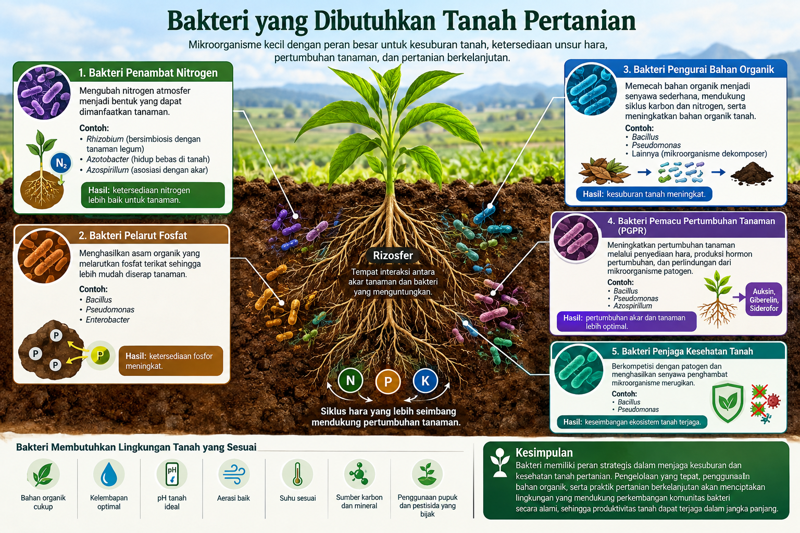
Soil bacteria can be found in very diverse numbers and types. Most of it is in the rhizosphere zone, which is the area of land that is directly influenced by plant root activity. Plant roots produce exudates in the form of organic compounds which can be a source of energy for microorganisms. As a consequence, the rhizosphere becomes an environment with relatively high microbiological activity. The interaction between roots and bacteria can have a positive influence on the availability of nutrients and the development of the root system.
One group of bacteria that is important for agricultural soil is nitrogen-fixing bacteria. Nitrogen is an essential element that plants need in the formation of proteins, nucleic acids, chlorophyll and various metabolic compounds. Although nitrogen is available in large quantities in the atmosphere, most plants cannot utilize it directly in that form. Certain bacteria have the ability to fix atmospheric nitrogen into a form of nitrogen that can enter the biological cycle. A widely known example is the Rhizobium group which has a symbiotic relationship with legume plants through the formation of root nodules. In addition, there are nonsymbiotic and associated nitrogen-fixing bacteria, such as Azotobacter and Azospirillum.
The next group is phosphate solubilizing bacteria. Phosphorus is an important element in energy metabolism, cell membrane formation, root development, and plant reproduction processes. The problem that is often found in agricultural soil is that some phosphorus is in bound form so it is not easily absorbed by the roots. Phosphate solubilizing bacteria can produce organic acids and other compounds that help increase the solubility of certain phosphates. Several genera, such as Bacillus and Pseudomonas, have been widely studied because of their potential to increase phosphorus availability for plants.
Decomposer bacteria also have an important function in maintaining soil fertility. Plant residues, straw, leaves, manure, and various other organic materials contain complex compounds that need to be broken down before the nutrients in them can become available again in the soil ecosystem. Bacteria and other microorganisms play a role in the decomposition process. Decomposer activity supports the carbon and nitrogen cycle and contributes to the formation of soil organic matter. Thus, the presence of adequate organic matter can be an important factor in maintaining soil microbiological activity.
Apart from their role in providing nutrients, some bacteria are also known as Plant Growth-Promoting Rhizobacteria (PGPR). This group is bacteria that are associated with plant roots and can have a positive influence on plant growth through various mechanisms. PGPR bacteria can help increase nutrient availability, produce compounds that influence root development, and interact with other microorganisms in the rhizosphere environment. Several groups of Bacillus, Pseudomonas, and Azospirillum are examples of bacteria that have been widely studied in this context.
In a soil health perspective, the presence of bacteria cannot be separated from the balance of the overall community of microorganisms. Healthy soil does not mean soil that only has one particular type of microorganism, but rather soil that has a biological community with relatively balanced diversity and function. Some bacteria can compete with pathogenic microorganisms for space and nutritional sources. Certain bacteria are also capable of producing metabolites that can inhibit the development of certain organisms that are detrimental to plants. This mechanism shows that bacteria are part of a complex biological system in maintaining the stability of agricultural ecosystems.
Nevertheless, the use of bacteria as biological agents or biofertilizers requires considering the environmental conditions of the soil. The effectiveness of a bacteria is greatly influenced by pH, humidity, temperature, availability of organic material, aeration, and chemical conditions of the soil. Bacteria that are effective in one location may not necessarily provide the same results in different agroecosystem conditions. Therefore, management of soil microorganisms should be carried out based on soil characteristics, plant types and local environmental conditions.
Based on this description, bacteria have a strategic function in maintaining the productivity and health of agricultural soil. Nitrogen-fixing bacteria, phosphate solubilizers, decomposers of organic matter, and plant growth-promoting bacteria are several groups that have important value in agricultural systems. However, the soil management approach should not be solely oriented towards adding certain microorganisms, but also creating conditions that support the development of natural microorganism communities. The use of organic materials, proper soil management, and the implementation of sustainable agricultural practices are important parts of building biological, productive, and sustainable soil ecosystems.
Literature
- Vessey, J. K. (2003). Plant growth promoting rhizobacteria as biofertilizers. Plant and Soil, 255, 571–586.
- Bhattacharyya, P. N., & Jha, D. K. (2012). Plant growth-promoting rhizobacteria (PGPR): Emergence in agriculture. World Journal of Microbiology and Biotechnology, 28, 1327–1350.