Together with Pokdartik Build a Smart Farming Project Using Cheap LoRaWAN Gateway with Reverse Engineer Used USB TV
The development of Internet of Things (IoT) technology has opened up great opportunities for the Indonesian agricultural sector to increase productivity, efficiency and quality of crop yields. One technology that is widely used in implementing Smart Farming is LoRaWAN (Long Range Wide Area Network), which is a low-power wireless communication system that can cover large areas of up to several kilometers. However, the relatively expensive price of LoRaWAN gateway devices is still an obstacle for many farmers, farming groups and technology communities in the regions.
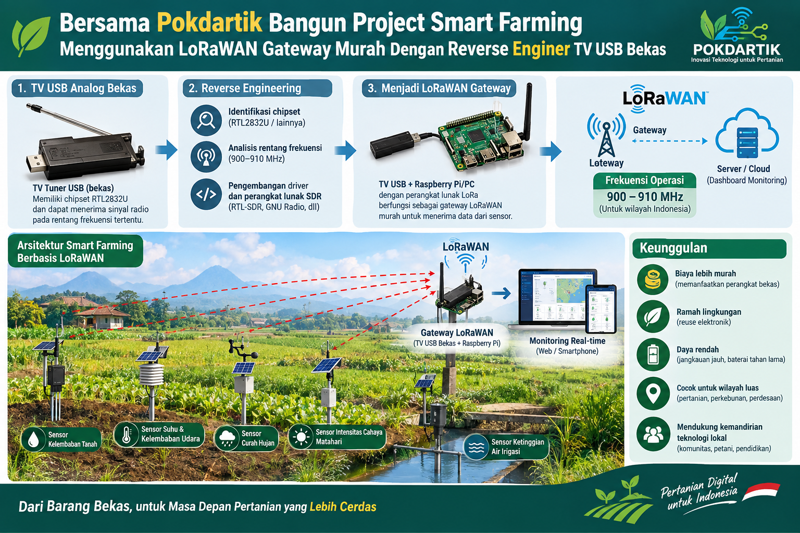
Through the spirit of innovation and reusing used electronic devices, Pokdartik encourages the development of LoRaWAN-based Smart Farming projects by utilizing used analog USB TV Tuners that are no longer in use. This device, which was previously used to receive analog television broadcasts, has the ability to receive radio signals in a certain frequency range which can be reused using Reverse Engineering techniques.
Reverse Engineering is the process of studying how hardware or software works to understand its internal function without having complete documentation from the manufacturer. In the context of used USB TVs, this process is carried out by identifying the chipset used, studying its radio frequency specifications, and developing software that allows the device to function as a LoRa signal receiver.
Most older generation analog USB TVs use the RTL2832U chipset which is very popular in the Software Defined Radio (SDR) community. With the help of open source software such as RTL-SDR, GNU Radio, and various digital signal processing libraries, this device can be modified into a low-cost radio spectrum monitoring tool or IoT signal receiver.
In the implementation of Smart Farming, a gateway built from a used USB TV functions to receive data from various sensors placed on agricultural land. These sensors can measure soil moisture, air temperature, environmental humidity, sunlight intensity, rainfall, and irrigation water surface height. The data received is then forwarded to a local server or cloud platform so that farmers can monitor land conditions in real-time via computer or smartphone.
The main advantages of using LoRaWAN are very low power consumption and long communication range. Sensors placed in rice fields or plantations can operate for months or even years using only small capacity batteries. This is very suitable for Indonesia's geographical conditions, which have large agricultural areas and are often far from conventional communications infrastructure.
In the process of Reverse Engineering a used USB TV into a cheap LoRaWAN gateway, several stages need to be carried out. The first stage is identification of the chipset and frequency capabilities of the device. The second stage is installing the SDR driver on the Linux operating system. The third stage is testing signal reception in the frequency range used by LoRaWAN. The fourth stage is the integration of the SDR device with LoRa packet processing software so that the sensor data can be translated and forwarded to the application server.
It should be noted that the gateway implementation resulting from Reverse Engineering has limitations compared to commercial LoRaWAN gateways that use the Semtech SX1301, SX1302, or SX1303 chipset. SDR gateways generally have more limited decoding capabilities and require greater computing resources. However, for research, education, laboratory needs, or small-scale community implementation, this solution is very attractive because development costs can be reduced significantly.
Apart from providing economic benefits, this project also supports the concept of environmental sustainability through reusing electronic waste. Analog USB TVs that previously became electronic waste can gain new functions as part of the Smart Farming infrastructure. This approach is in line with circular economy principles that encourage the reuse of electronic devices to extend their useful life.
For Indonesia, LoRaWAN implementation must pay attention to applicable frequency regulations. The LoRa Alliance stipulates that Indonesia uses the AS923-2 channel with an operating range of around 920–923 MHz so that the gateway and node frequency settings must be adjusted to comply with applicable regulations. Using the right frequency will ensure the system works optimally and does not interfere with other radio services.
Through collaboration between the technology community, academics, farmers and Pokdartik, the development of a cheap LoRaWAN gateway based on Reverse Engineering used USB TVs can be an innovative solution to accelerate the digital transformation of Indonesia's agricultural sector. With more affordable costs, more farmers can access Smart Farming technology and utilize data effectively to increase production yields as well as efficient use of agricultural resources.
This project proves that innovation doesn't always have to start with expensive devices. With creativity, technical knowledge and a spirit of mutual cooperation, used electronic devices can be transformed into technology that provides real benefits for society and Indonesia's agricultural development in the digital era.
Literature
- LoRa Alliance. RP2-1.0.1 LoRaWAN Regional Parameters. LoRa Alliance, 2020.
- LoRa Alliance. LoRaWAN Regional Parameters RP002-1.0.5. LoRa Alliance, 2025.
- LoRa Alliance. LoRaWAN 1.1 Regional Parameters Specification. LoRa Alliance
- The Things Network. LoRaWAN Frequency Plans Repository. GitHub Documentation.
- The Things Industries. Frequency Plans for LoRaWAN Networks. Technical Documentation