Biochar's Ability During Extreme Rain: Retaining Water, Retaining Nutrients, Saving Soil
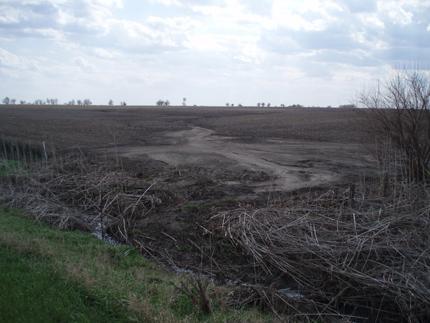
Climate change makes rainfall patterns increasingly erratic. In many tropical agricultural areas, extreme rain in a short period of time often causes puddles, leaching of nutrients, and even soil erosion. This condition is detrimental to farmers because fertilizer is lost before it can be absorbed by plants, soil structure is damaged, and root growth is disrupted. In situations like this, biochar plays an important role as a natural soil buffer.
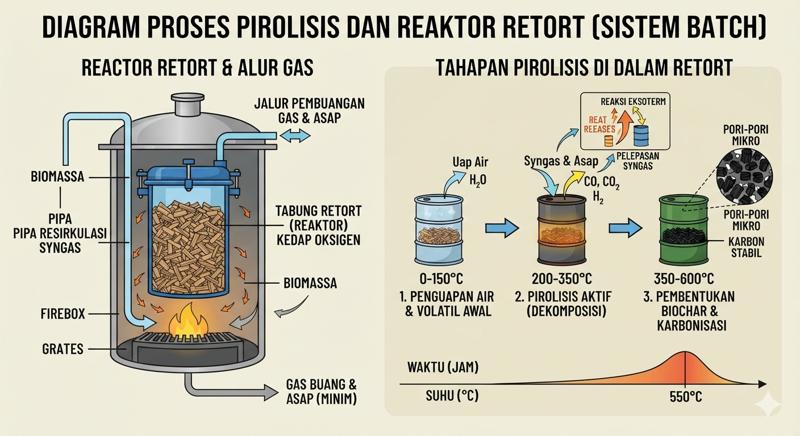
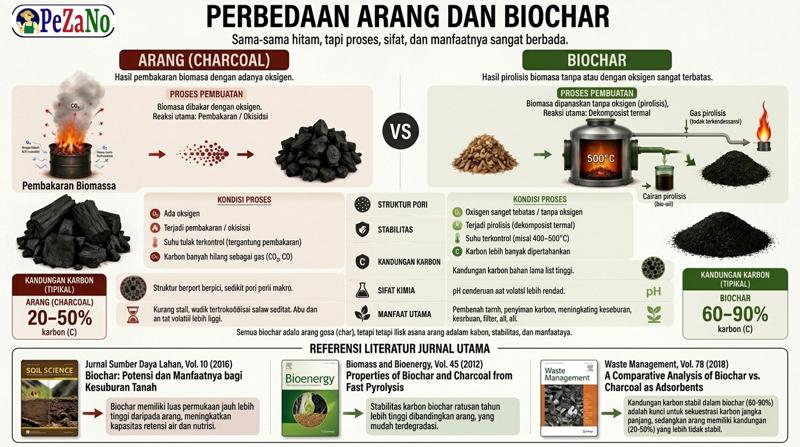
Biochar is biological charcoal resulting from biomass pyrolysis which has a highly porous structure and is stable in the soil. Its physical and chemical properties make it capable of working as a “stabilizer” when the land faces excessive water pressure due to extreme rain.
1. Reduces Nutrient Leaching
One of the biggest impacts of extreme rain is leaching or leaching of nutrients, especially nitrogen and potassium. In soil without amendments, excessive rainwater will dissolve the nutrients and then carry them down to the soil layers that the roots cannot reach.
Biochar has a very large surface area and a natural negative charge. This structure allows biochar to bind cations such as:
-
NH4⁺ (ammonium)
-
K⁺ (potassium)
-
Ca²⁺ (calcium)
-
Mg²⁺ (magnesium)
When heavy rain falls, nutrients that are usually washed away can be “retained” while on the surface of the biochar. After soil conditions return to normal, these elements remain available to plants. Thus, biochar functions like a nutrient bank that prevents fertilizer loss during heavy rains.
2. Increases Infiltration and Reduces Ponding
Soil that is dense or poor in organic matter tends to have difficulty absorbing water quickly. As a result, extreme rain causes puddles on the surface, which can:
-
Inhibits root respiration
-
Triggers root rot
-
Reduces aerobic microbial activity
Biochar helps improve soil structure by creating additional pore space. In heavy clay soils, biochar helps break up the density of soil aggregates so that water can penetrate more easily. In sandy soil, biochar increases water holding capacity so that the soil does not dry out immediately after the rain stops.
With better infiltration, surface runoff is reduced and the risk of inundation is reduced.
3. Reducing Soil Erosion
Extreme rainfall is often accompanied by strong surface flows. Soil that is loose but unstable is easily eroded and carried away by water. The top layer of soil (topsoil) which is rich in organic matter and nutrients can be lost in just one heavy rain event.
Biochar plays a role in strengthening soil aggregates. When mixed with soil and other organic materials, biochar helps form a more stable soil structure. This structure:
-
More resistant to raindrops
-
Reduces loose soil particles
-
Suppresses topsoil loss
In the long term, soil containing biochar is more resistant to physical damage due to extreme weather.
4. Maintaining Microorganism Activity
Extreme rainy conditions often cause drastic fluctuations in humidity and temperature.Sensitive soil microorganisms can be disturbed or die if conditions are too saturated with water.
The porous structure of biochar provides a relatively stable microspace for microbes. In these tiny pores, microorganisms are protected from sudden environmental changes. As a result:
-
Soil biological activity is maintained
-
The process of decomposition and nutrient mineralization continues
-
Soil recovers more quickly after extreme rain
Biochar functions as a buffer for micro ecosystems in the soil.
5. Reducing Post-Rain
Greenhouse Gas EmissionsSoil that is saturated with water for a long time can experience anaerobic conditions. Under these conditions, the production of gases such as nitrous oxide (N₂O) and methane (CH₄) increases. Both of these gases are strong greenhouse gases.
Several studies show that biochar can help reduce N₂O emissions by increasing soil aeration and regulating the nitrification-denitrification process. Although the effect depends on the type of soil and biochar, in general biochar helps create a more balanced soil condition after extreme rain.
6. Long-Term Effects in Extreme Climate System
sThe main advantage of biochar is its stability. In contrast to fresh organic material which decomposes quickly, biochar can last for decades in the soil. This means that protection against the effects of extreme rain is not just for one season, but lasts a long time.
However, it needs to be understood that biochar is not an instant solution. It does not prevent major flooding directly, but improves the character of the soil to make it more resilient to excess water pressure. Optimal effects are usually visible after several months to several growing seasons, especially when combined with:
-
Compost
-
Natural mulch
-
Good drainage management