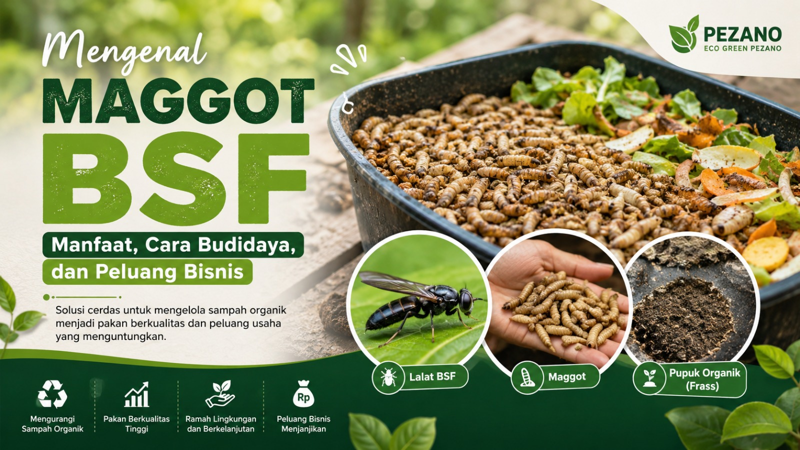
Getting to Know BSF Maggots: Benefits, Cultivation Methods and Business Opportunities
In the midst of the increasing amount of organic waste and the need for environmentally friendly solutions, the Black Soldier Fly (BSF) maggot appears as an innovation that is increasingly in demand. BSF Maggot is not only able to reduce organic waste effectively, but also has high economic value. Various groups, from farmers, breeders, to business people, are starting to use maggots as an alternative animal feed as well as a promising business opportunity.
What is a BSF Maggot?
BSF maggots are the larvae of the Black Soldier Fly (Hermetia illucens). Unlike house flies, BSF flies do not carry disease because they do not land on human food or dangerous waste. Adult flies only live a few days with the main goal of breeding, so their existence is relatively safe for the environment.
In the larval phase, maggots have the extraordinary ability to break down various types of organic waste, such as vegetable scraps, fruit, tofu dregs and kitchen waste. In a short time, the larvae are able to convert this waste into biomass which is rich in protein and fat.
Benefits of BSF Maggots
Maggot BSF offers various benefits that make it a sustainable solution for society.
First, maggots can help reduce the volume of organic waste. Waste that usually accumulates in landfills can be processed into useful resources. This process helps reduce environmental pollution while reducing greenhouse gas emissions from decomposing waste.
Secondly, maggots have high nutritional content. The high crude protein content makes it an alternative feed for fish, chickens, ducks, birds and several other types of livestock. Using maggots as feed can help reduce dependence on commercial feed, the prices of which tend to continue to increase.
Third, the results of maggot cultivation also produce organic residue or frass which can be used as organic fertilizer. Frass contains nutrients that are useful for increasing soil fertility so it is very suitable for use in the agricultural sector.
How to Cultivate BSF Maggots
BSF maggot cultivation is relatively easy and can be done on a household or commercial scale. The first step is to prepare a cage or breeding place for BSF flies. The cage should have good air circulation, enough light, and be protected from rain.
After flies lay eggs, the eggs will hatch into larvae within a few days. The larvae are then transferred to media containing organic waste such as vegetable, fruit or food waste that is still suitable for processing. Feeding is carried out regularly so that larval growth occurs optimally.
In about 14–18 days, maggots will reach harvest size. At this stage, the larvae can be directly used as animal feed, dried into maggot meal, or sold to livestock breeders and fish farmers. Some larvae should be allowed to develop into pupae and adult flies so that the cultivation cycle continues.
BSF Maggot Business Opportunities
Demand for BSF maggots continues to increase along with the development of the livestock and aquaculture sectors. This condition opens up quite extensive business opportunities for the community.
The main products that can be sold include fresh maggots, dried maggots, maggot flour, BSF eggs, maggot seeds, and organic fertilizer from frass. Apart from that, business actors can also offer organic waste management services to households, restaurants, traditional markets and agencies that produce large amounts of organic waste.
The initial capital for maggot cultivation is relatively affordable because the main raw material comes from organic waste which is easy to find. With good management, this business has the potential to provide profits as well as have a positive impact on the environment.
Challenges in Cultivation
Even though it has many advantages, maggot cultivation still requires attention to several important aspects. The cultivation location must be kept clean so that it does not cause disturbing odors. Apart from that, it is necessary to pay attention to the quality of organic feed so that the larvae grow healthy and are free from harmful substances.
Breeders also need to understand the life cycle of the Black Soldier Fly so that the production process runs sustainably. Education and training are important factors to increase the success of cultivation, especially for beginners.
Closing
Maggot BSF is an innovation that is able to answer two challenges at once, namely managing organic waste and providing quality feed sources. With a relatively simple cultivation process, various benefits, and growing business opportunities, maggots are an attractive choice for people who want to start a circular economy-based business.
By utilizing BSF maggots, organic waste is no longer seen as a problem, but as a valuable resource. If more and more people implement maggot cultivation in a sustainable manner, the impact will not only increase income, but also help create a cleaner, healthier and more sustainable environment for future generations.