No-Till SandWich Organic: ABC Agriculture Solution to Facing El Niño and La Niña in Indonesia
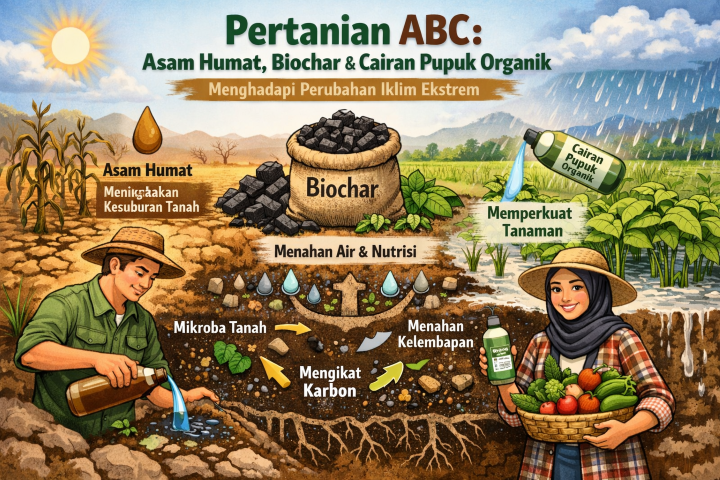
Global climate change is increasingly having a real impact on the agricultural sector in Indonesia. The two phenomena that most often influence national food production patterns are El Nino and La Nina. El Niño usually brings long dry seasons, droughts and irrigation water crises, while La Niña triggers excessive rainfall which has the potential to cause flooding, erosion and plant disease attacks. In these increasingly uncertain conditions, farmers need cultivation systems that are adaptive, cost-effective and sustainable. One innovative approach that can be applied is No-Till SandWich Organic as part of the ABC Agriculture concept (Humic Acid, Biochar and Organic Fertilizer Liquid).
No-Till SandWich Organic is a no-till cultivation method that utilizes a layer of organic material as a “sandwich” naturally above ground level. This system avoids intensive soil turning so that the soil structure is maintained. In conventional practice, excessive tillage can damage soil aggregates, accelerate water evaporation, and reduce organic matter content. On the other hand, the no-till approach maintains soil moisture and increases the activity of microorganisms which play an important role in land fertility.
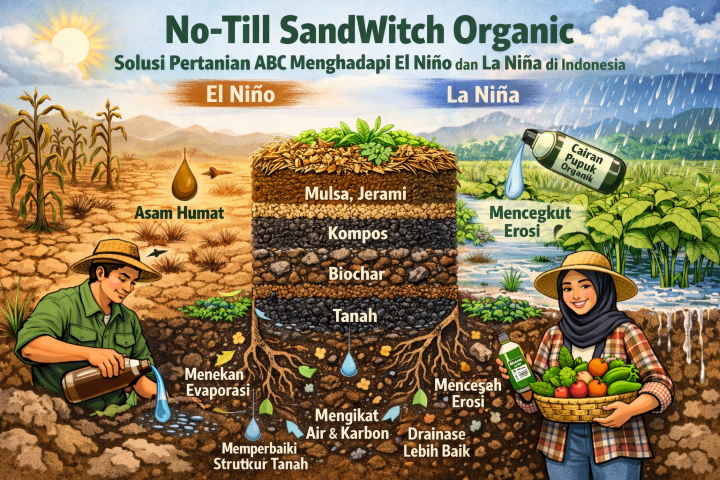
The “sandwich” This method refers to the preparation of several layers of organic materials such as straw, compost, biochar, and liquid organic fertilizer which are applied in stages. The first layer functions as a soil cover (mulch) to reduce water evaporation and protect the soil surface from heavy rain. The next layer is enriched with humic acid and biochar to increase the soil's capacity to store water and nutrients. Liquid organic fertilizer is then applied to accelerate the biological activity of the soil while providing nutrients that are easily absorbed by plants.
When El Niño hits and rainfall decreases drastically, farmers' main challenge is water availability. This is where the advantages of SandWich Organic's No-Till system become apparent. A layer of organic mulch can reduce the rate of evaporation so that soil moisture lasts longer. Porous biochar works like a natural sponge, absorbing and storing large amounts of water, then releasing it slowly according to the needs of plant roots. Humic acid helps improve soil structure so that roots can grow deeper and find remaining water sources. With this combination, plants become more resistant to drought stress.
On the other hand, when La Niña brings high rainfall and the risk of inundation increases, this system also remains relevant. Soil that is not over-plowed has a more stable aggregate structure and is able to absorb rainwater better. Biochar increases soil porosity so that drainage becomes smoother and the risk of root rot can be minimized. In addition, the organic layer on the soil surface reduces the direct impact of raindrops, so that erosion can be suppressed. As a result, the land remains productive even when facing extreme rain.
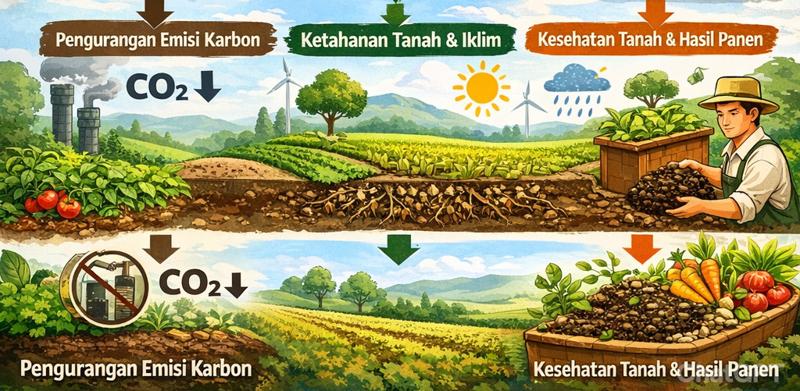
This approach also provides long-term ecological benefits. Without intensive tillage, carbon emissions from the soil can be reduced. Biochar plays a role in binding carbon over a long period of time, helping to mitigate climate change.Meanwhile, the use of liquid organic fertilizer reduces dependence on synthetic chemical fertilizers which have the potential to damage the balance of the soil ecosystem. Increased soil microbial activity contributes to more efficient natural nutrient cycling
From an economic perspective, No-Till SandWich Organic is relatively cost-effective because it uses local agricultural waste such as straw and rice husks. Farmers do not need to cultivate land repeatedly which requires additional fuel and labor. Irrigation costs can also be reduced because the soil is better able to retain water. In the long term, stable productivity amidst extreme climate conditions will provide better income certainty for farmers.
Apart from that, this method supports national food security. With a system that is adaptive to El Niño and La Niña, the risk of crop failure can be reduced. Agricultural production becomes more consistent despite weather fluctuations. This is very important for Indonesia as an agricultural country with a large population that depends on the stability of food supplies.
Implementation of No-Till SandWich Organic does require initial education and assistance so that farmers understand the techniques for preparing organic layers and the correct application doses of humic acid, biochar and liquid organic fertilizer. However, once the system is established and soil balance is achieved, maintenance is relatively easier compared to conventional systems that rely on high chemical inputs.
In the end, No-Till SandWich Organic is not just a cultivation technique, but a transformation of the way we view soil management. Soil is no longer treated as a passive medium, but as a living ecosystem that needs to be maintained in balance. By integrating ABC Agriculture principles, Indonesian farmers have a great opportunity to face the challenges of El Niño and La Niña more resiliently, sustainably and productively. This approach is a strategic step towards future agriculture that is adaptive to climate change and environmentally friendly.