The Role of Organic Materials in Increasing Soil Bacterial Activity
Organic material is an important component in maintaining the quality and productivity of agricultural land. The presence of organic matter not only functions as a source of nutrients for plants, but also as a source of energy and habitat for various soil microorganisms. In the context of soil microbiology, organic matter has a close relationship with the presence and activity of bacteria which play a role in the processes of decomposition, mineralization and nutrient cycling.
Agricultural soils that have low organic matter content generally have more limited biological activity. Reduction of organic matter can occur due to intensive tillage, transportation of plant residues from the land, excessive use of chemical inputs, and low return of biomass to the soil. This condition can cause a reduction in the carbon sources needed by microorganisms to maintain their metabolic activities. Therefore, managing organic matter is an important part of building a soil ecosystem that supports bacterial life.
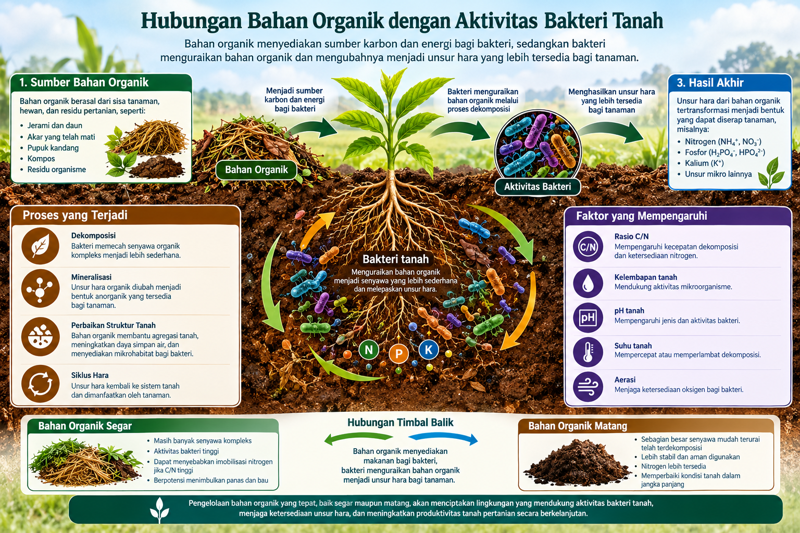
Organic materials derived from straw, leaves, roots, manure, compost and plant residues contain various organic compounds that can be utilized by microorganisms. Decomposer bacteria use some of these compounds as a source of energy and carbon. In the decomposition process, complex organic compounds are broken down into simpler compounds. This process allows nutrients that were previously bound in organism tissues to become part of the soil nutrient cycle.
One of the important processes related to the activity of microorganisms is mineralization. Through this process, elements that are in organic form can undergo transformation into inorganic forms that are more available to plants. Nitrogen is one of the elements that undergoes this process. The activity of soil microorganisms helps regulate changes in the form of nitrogen so that its presence can follow the nitrogen cycle in the ecosystem.
Apart from providing a carbon source, organic matter also contributes to the physical condition of the soil. Continuous addition of organic matter can help improve soil aggregation, increase the soil's ability to retain water, and provide microhabitat space for soil organisms. Better physical conditions can create an environment that is more suitable for the development of microorganism communities.
The relationship between organic matter and bacteria can also be found in the rhizosphere region. Plant roots produce exudates in the form of organic compounds that can be utilized by bacteria around the roots. These interactions form a dynamic relationship between plants, roots, bacteria and the soil environment. Some rhizosphere bacteria can help provide nutrients, produce compounds that support plant growth, and compete with potentially harmful microorganisms.
However, increasing organic matter does not mean that all types of organic matter have the same effect. Ingredient characteristics, maturity level, carbon to nitrogen ratio, humidity, and environmental conditions can influence the rate of decomposition and the response of microorganisms. Mature compost, for example, has different characteristics from fresh plant material.Therefore, the use of organic ingredients needs to consider the quality and level of maturity.
In sustainable agricultural practices, returning plant residues to the land is one strategy for maintaining soil carbon sources. The use of compost and organic fertilizer that has been well decomposed can also be part of this management. This approach is not only aimed at increasing the organic matter content, but also at creating ecological conditions that allow soil microorganisms to develop more stably.
Thus, management of soil bacteria cannot be separated from management of organic matter. Bacteria need an energy source and an environment that supports their life, while bacterial activity helps convert organic matter and return nutrients to the soil system. This reciprocal relationship shows that soil fertility is the result of interactions between physical, chemical and biological components.
Soil management that is oriented towards increasing biological activity needs to place organic matter as one of the main foundations. Maintaining plant residues, using compost, reducing soil disturbance, and proper water management and aeration can create an environment that is more supportive of bacterial communities. With this approach, soil is not only viewed as a medium to support plants, but as a living ecosystem that has the biological ability to maintain its productivity.
In the end, the existence of beneficial bacteria does not depend solely on inoculation or the addition of external microbial products. A more fundamental factor is the availability of habitat and energy sources that allow these microorganisms to survive and develop. Organic materials are one component that can provide these needs. Therefore, improving the biological quality of soil through organic matter management is an important strategy to support a productive, efficient and sustainable agricultural system.
Literature
- Lehmann, J., & Kleber, M. (2015). The contentious nature of soil organic matter. Nature, 528, 60–68.
- van Veen, J. A., van Overbeek, L. S., & van Elsas, J. D. (1997). Fate and activity of microorganisms introduced into soil. Microbiology and Molecular Biology Reviews, 61(2), 121–135.