Urban Farming: Farming Solutions on Narrow Land
In the midst of rapid urban development, green land is increasingly limited due to the development of settlements, buildings and infrastructure. This condition makes many people think that farming can only be done in rural areas with large areas of land. In fact, advances in technology and community creativity have given birth to the concept of urban farming, which allows anyone to grow crops even if they have little land.
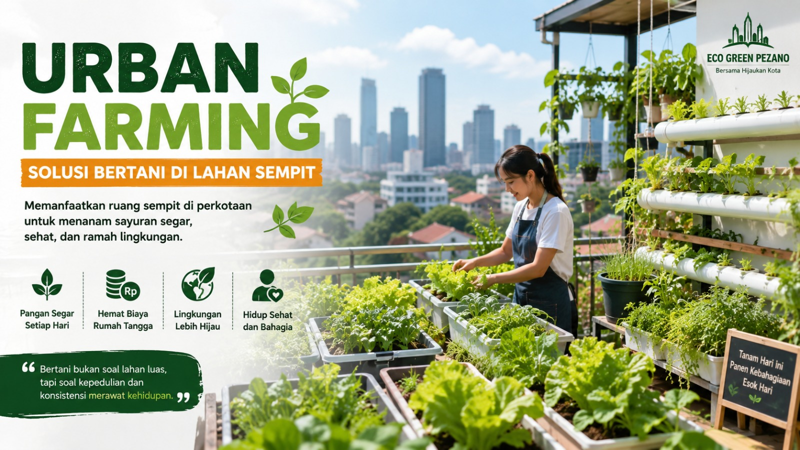
Urban farming is the activity of planting, cultivating and utilizing food plants and ornamental plants in urban environments. This activity can be carried out in the yard, small yard, balcony, roof top, and even the walls of the house using the vertical method. By making maximum use of available space, people can still produce fresh food while creating a greener environment.
What is Urban Farming?
Urban farming is an agricultural system carried out in urban areas by utilizing limited space. In contrast to conventional agriculture which requires large areas of land, urban farming emphasizes efficient use of space and the application of simple and modern technology.
Various methods can be applied in urban farming, such as hydroponics, aquaponics, verticulture, and even the use of pots or polybags. These methods are designed so that plants can still grow well even in densely populated environments.
Apart from producing food, urban farming is also part of a sustainable lifestyle that encourages people to care more about the environment and family food security.
Urban Farming Benefits
Urban farming provides many benefits, both from an economic, environmental and health perspective.
One of the main benefits is helping to meet the family's food needs. Vegetables such as kale, spinach, mustard greens, lettuce, chilies, tomatoes and various herbal plants can be harvested directly from home so they are fresher and free from excessive use of chemicals.
From an economic perspective, urban farming is able to reduce household expenses because some vegetable needs can be met independently. In fact, if the harvest is abundant, the product can be sold to neighbors or the local community, thus becoming a source of additional income.
Another benefit is improving environmental quality. Plants are able to absorb carbon dioxide, produce oxygen, and help lower the temperature around the house. The presence of plants also makes the environment more beautiful, comfortable and healthy.
Apart from that, gardening also has psychological benefits. Caring for plants can reduce stress, improve mood, and be a positive activity with the family. Children can also learn to recognize the process of plant growth while developing a love for nature.
How to Start Urban Farming
Starting urban farming is actually not difficult. The first step is to determine a location that gets enough sunlight, at least four to six hours every day. This area can be the front yard, backyard, balcony, or roof of the house.
Next, choose the appropriate planting medium. Pots, polybags, used buckets, plastic bottles, or PVC pipes can be used as planting containers.Using used goods not only saves costs, but also helps reduce waste.
The choice of plant type is also very important. For beginners, it is best to choose plants that are easy to care for, such as kale, spinach, lettuce, mustard greens, chilies, tomatoes, spring onions or basil. These plants have a relatively short harvest period so the results can be enjoyed immediately.
Treatment is carried out by watering the plants regularly, providing organic fertilizer, and controlling pests using natural methods whenever possible. Consistency in caring for plants is the key to successful urban farming.
Challenges and Solutions
Even though it offers many benefits, urban farming also has several challenges. One of them is limited space which means that the number of plants is not as large as farming in rural areas. However, this challenge can be overcome by implementing a verticulture system or multi-tiered shelves so that planting capacity is maximized.
Another challenge is limited time for urban communities who have busy activities. To overcome this, you can use an automatic watering system or choose plants that do not require intensive care.
Apart from that, the quality of the planting media and lighting also needs to be considered so that plants can grow optimally. With good planning, these various obstacles can be minimized.
Urban Farming for a Sustainable Future
Urban farming is not just a trend, but a real solution in facing the challenges of food security, climate change and limited land in urban areas. Through this activity, people can utilize empty space into a productive area that produces healthy food while beautifying the environment.
The more people who implement urban farming, the greater the positive impact that can be felt. Apart from reducing dependence on food supplies from outside the region, urban farming also encourages the creation of a greener, healthier and more sustainable environment.
In the end, urban farming proves that farming does not always require large areas of land. With creativity, a willingness to learn, and the use of simple technology, anyone can become part of the urban farming movement. Small steps starting from the home yard can provide big benefits for families, the environment and the future of Indonesia's food security.